Cloudflare R2 vs AWS S3 (2026): Costs, Egress & Managing Buckets on Mac
Short answer: Cloudflare R2 is cheaper than AWS S3 for almost any workload that serves data to the internet. R2 storage costs $0.015 per GB-month against $0.023 on S3 Standard, and R2 charges $0 for egress against about $0.09 per GB on S3. S3 still wins when you need AWS-native integrations or run millions of tiny writes.
Same workload, two bills
| Monthly workload | Cloudflare R2 | AWS S3 Standard (us-east-1) |
|---|---|---|
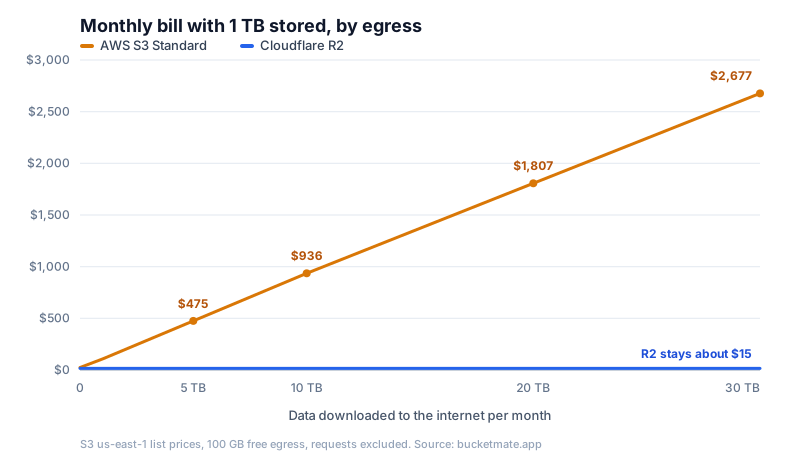
| 1 TB stored, 1 TB downloaded | about $15 | about $107 |
| 5 TB stored, 30 TB downloaded | about $77 | about $2,800 |
| 50 TB stored, almost no egress | about $768 | about $1,180 |
Estimates cover storage and internet egress only. Requests are extra on both, and AWS includes 100 GB of free egress per month. Adjust the numbers for your own workload with the calculator below.
This guide compares Cloudflare R2 and Amazon S3 across cost, integrations, compliance, and migration.
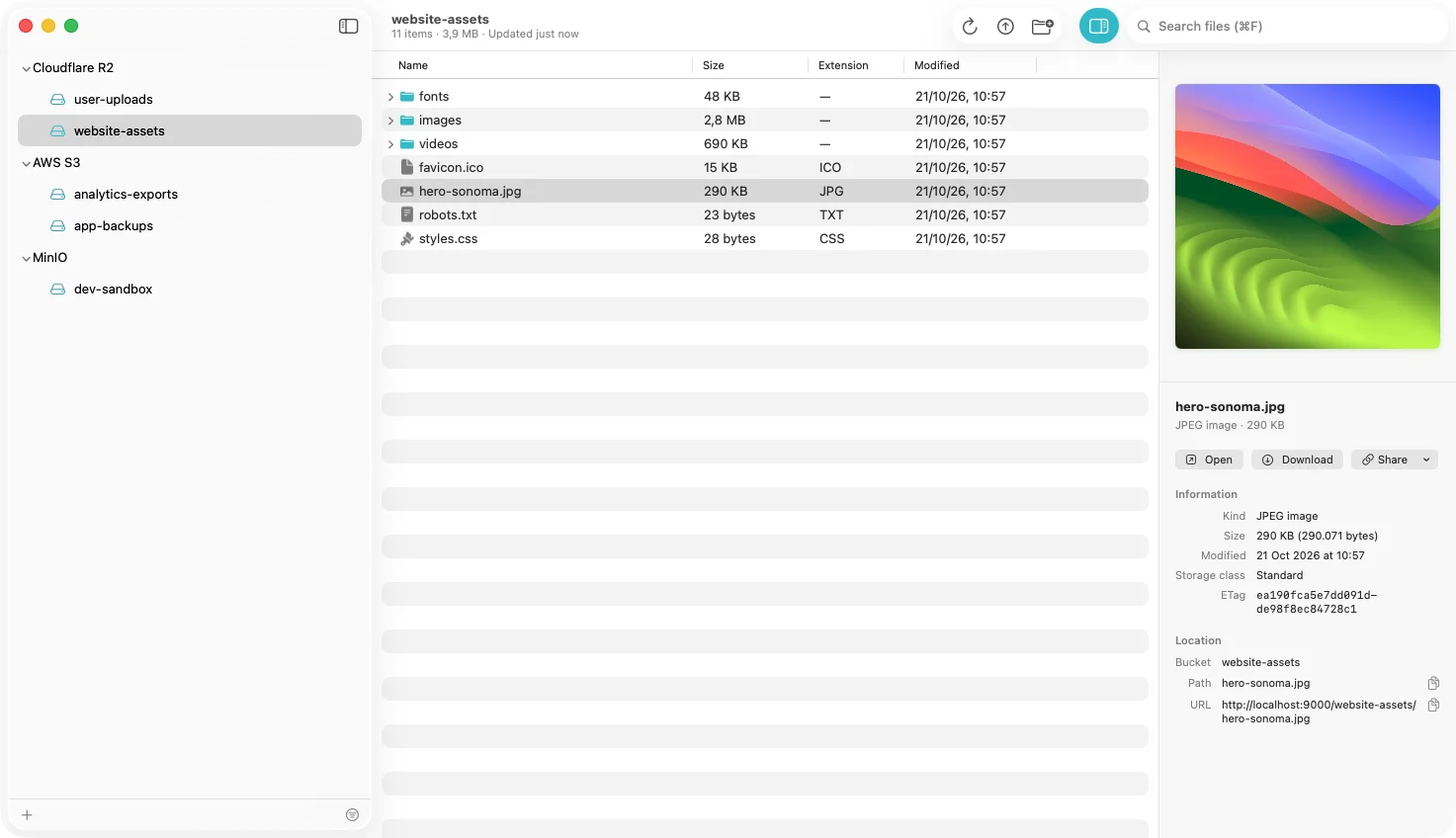
Manage R2 from your Mac. Whichever you pick, you can browse R2 and S3 buckets side by side like a file manager. See the Cloudflare R2 GUI for macOS guide.
Snapshot: who should choose which?
- Cloudflare R2 is ideal when outbound bandwidth dominates your bill, you are serving public assets, or you want predictable pricing for cross-cloud architectures.
- AWS S3 is the safer play if you live inside AWS already, need deep integrations with native analytics and event services, or require every regulatory checkbox in one place.
- Hybrid strategies increasingly pair R2 for hot, bandwidth-heavy workloads with S3 for private data lakes and AWS-native processing. On a Mac - and in the iOS and Web apps - a multi-provider S3 GUI lets you browse both without two dashboards.
2026 cost comparison
| Item | Cloudflare R2 | AWS S3 Standard (us-east-1) |
|---|---|---|
| Storage | $0.015 per GB-month | $0.023 per GB-month |
| Egress | $0.00 per GB | $0.09 per GB (first 10 TB) |
| Class A requests (PUT, COPY, POST, LIST) | $4.50 per million | $0.005 per 1,000 |
| Class B/GET requests | $0.36 per million | $0.0004 per 1,000 |
| Early delete | None | None for S3 Standard |
Numbers reflect the current Cloudflare R2 pricing and Amazon S3 pricing pages; double-check AWS regional variations before committing.
See how the math changes for your footprint by adjusting storage and bandwidth sliders below.
Scenario math: when the dollars diverge
- Bandwidth-heavy SaaS: 5 TB stored, 30 TB outbound each month. R2 lands near $75 for storage plus request traffic. S3 approaches $2,800 once tiered transfer fees stack, even before CloudFront relief.
- Embedded in AWS analytics: 50 TB stored, negligible egress, thousands of Lambda and Glue jobs. S3 stays close to $1,180 on storage plus request charges, and the built-in IAM, EventBridge, and Athena hooks save operational work that R2 would push to third-party tools.
- Cross-cloud content distribution: Teams running on Fly.io, Vercel, or Kubernetes clusters in multiple clouds often push build artifacts and static bundles to R2, avoiding interconnect surprises while keeping a backup copy in S3 Glacier or Deep Archive.
Ecosystem and feature depth
- Integrations: S3 still owns deeper integrations with AWS services (EventBridge, Lambda notifications, S3 Select, Lake Formation). R2 covers S3-compatible APIs, Workers bindings, and Queues, plus open-source tooling.
- Compliance: Both offer SOC 2 Type II, ISO 27001, and GDPR coverage, but certain regulated workloads (FedRAMP High, DoD IL5) remain AWS-only for now.
- Identity and IAM: AWS IAM delivers fine-grained policies, SCPs, and Control Tower guardrails. Cloudflare leans on scoped API tokens and service bindings; Workers AI and Access help extend policies, but per-request condition keys are still richer on AWS.
- Performance: Latency differences shrink when R2 sits behind Cloudflare’s global edge, while S3 benefits from multi-AZ durability and features like Transfer Acceleration. Benchmark heavy workloads with realistic object sizes; R2 shines with large sequential transfers, S3 retains an edge on metadata-intensive jobs.
Hidden costs and operational overhead
- Networking: AWS credits egress when traffic flows through CloudFront or PrivateLink, but only for supported patterns. R2 eliminates egress fees entirely, yet you still pay for Workers invocations or HTTP requests at the edge.
- Request amplification: Highly transactional apps (millions of small PUTs) can be cheaper on S3 because of lower per-request pricing. Consider buffering writes or using Cloudflare Queues to batch traffic into R2.
- Data mobility: R2’s no-egress stance is compelling for multi-cloud migrations, while S3 lifecycle policies and replication across regions (or to Glacier tiers) reduce manual data wrangling.
Decision matrix for 2026
- Choose Cloudflare R2 if you prioritize zero egress, operate outside AWS, or want predictable spend for public assets, SaaS downloads, gaming content, or AI model distribution.
- Choose AWS S3 if your data pipelines, ML training, or governance stack already depends on AWS-native services, or if you need every storage class variation, object-level logging, and mature replication policies.
- Run dual providers when you want R2 serving customer-facing assets and S3 retaining a canonical copy for compliance, analytics, or cross-region restores.
Migration checklist with BucketMate on macOS
- Map buckets and workloads: Inventory object counts, size distribution, lifecycle policies, and identity providers. Flag applications tightly coupled to S3-only features such as EventBridge or Lambda triggers.
- Create destination storage: Set up Cloudflare R2 buckets with matching naming conventions and retention requirements. Ensure API tokens carry read and write scope. On AWS, create staging buckets or Glacier targets if you plan to keep a backup.
- Connect accounts in BucketMate: Open BucketMate on macOS, iOS, or Web, add an AWS S3 connection with IAM user credentials, then add Cloudflare R2 using the account ID endpoint and API token.
- Test head-to-head transfers: Use BucketMate’s dual-pane view to drag a sample folder from S3 to R2. Confirm metadata, storage class choices, and object versions copy correctly. Validate permissions by attempting reads from your application.
- Plan bulk migration: For large datasets, schedule
aws s3 syncto a local cache or directly to R2 endpoints, or rely on BucketMate’s queueing to move collections in batches during off-peak windows. Track API rate limits to avoid throttling. - Cut over and monitor: Update application endpoints, CDN origins, or signed URLs to point at R2. Keep S3 replication or lifecycle policies running until you confirm durability parity. Watch BucketMate’s transfer logs and Cloudflare analytics for errors.
- Optimize ongoing spend: Enable Cloudflare cache rules, review S3 Intelligent-Tiering or Glacier transitions for remaining copies, and automate health checks via Workers or AWS CloudWatch.
FAQ
Is Cloudflare R2 cheaper than AWS S3?
Yes for most workloads that serve data to users. R2 storage is $0.015 per GB-month against $0.023 on S3 Standard, and R2 has no egress fee. A workload with 1 TB stored and 1 TB downloaded costs about $15 per month on R2 and about $107 on S3.
When is AWS S3 the better choice?
Choose S3 when your stack depends on AWS-native services such as Lambda triggers, EventBridge, Athena, or Glacier tiers, or when compliance needs such as FedRAMP High require AWS. S3 can also be cheaper for write-heavy apps with millions of tiny objects.
Is Cloudflare R2 compatible with the S3 API?
Yes. R2 supports the S3 API, so the AWS CLI, AWS SDKs, rclone, and S3 GUI clients work with it. Set the endpoint to https://ACCOUNT_ID.r2.cloudflarestorage.com and the region to auto.
Can I manage R2 and S3 buckets in one app?
Yes. BucketMate connects to Cloudflare R2, AWS S3, and other S3-compatible providers side by side on macOS, iOS, and Web, so you can browse and copy objects between them without two consoles.
Manage R2 and S3 side by side
After the cost math, download BucketMate for macOS, get the iOS app, or open the Web app to browse R2 and S3 like a file manager. See best S3 GUI for macOS and Cloudflare R2 GUI for macOS.
Related resources
- For a dedicated rate-card breakdown, see Cloudflare R2 pricing 2026.
- Configure credentials in the Cloudflare R2 S3 endpoint setup guide (CLI, SDK, and BucketMate on macOS, iOS, and Web).
- Browse R2 like a file manager: Cloudflare R2 GUI for macOS.
- Follow the AWS S3 + BucketMate integration playbook for credential best practices, then apply the same patterns when you run hybrid storage.
- Staying on S3? Cut storage costs with S3 lifecycle rules and versioning.
- Compare desktop clients in best S3 GUI for macOS.